My old man's a white old man
And my old mother's black.
If ever I cursed my white old man
I take my curses back.
If ever I cursed my black old mother
And wished she were in hell,
I'm sorry for that evil wish
And now I wish her well
My old man died in a fine big house.
My ma died in a shack.
I wonder were I'm going to die,
Being neither white nor black?
-------------------------------------------------------------------------------------
ANOTHERRR POEEMMM! okay so in this poem "Cross" By Langston Hughes I THINK that he is speaking with a tone of forgiveness, confusion, and curiosity because in the beginning when he talks about his parents he apologizes to both of them for all the evil wishes he had and all the curses he said.
" If ever I cursed my white old man
I take my curses back.
If ever I cursed my black old mother
And wished she were in hell,
I'm sorry for that evil wish"
i think that society is being addressed since he is speaking with a tone of curiosity he is asking questions about his thoughts and confusion. i think he is also pretty much just emptying his random thoughts that everyone in the world have into this poem and the subject is just where he is going to die, which I'm sure most of us have thought about. but the twist that he adds to this poem is the racial aspect because he feels that race will have an effect on where you die
"My old man died in a fine big house.
My ma died in a shack.
I wonder were I'm going to die,
Being neither white nor black? "
his dad being white, died in a nice rich place, and his mother being black she died in "shack"
in the poem he definitely uses rhymes as a poetic device but i feel like the one that stands out in this poem is hyperbole because i feel like when he says that whites die in a nice rich places and black die in shacks i feel as if he went a little too far, or over exaggerated thing by a lot, because i don't feel as if race has an effect on where you die.
the HR theme in this poem i would say is, definitely identification with race. i think this because i feel that he doesn't know which race that he should or want to identify with and that is really what this poem is all about his thoughts on his racial identity. i somewhat like this poem but then i somewhat do not like this poem. i like this poem because just like "Merry-Go-Round" it gets you thinking about what the deeper meaning is and its also short, but then i don't like how he was saying how your race has an effect on were you die and i some what think that, that takes away from the poem.
Tuesday, March 8, 2011

Merry-Go-Round by Langston Hughes
Where is the Jim Crow section
On this merry-go-round,
Mister, cause I want to ride?
Down South where I come from
White and colored
Can't sit side by side.
Down South on the train
There's a Jim Crow car.
On the bus we're put in the back—But there ain't no back
To a merry-go-round!
Where's the horse
For a kid that's black?
On this merry-go-round,
Mister, cause I want to ride?
Down South where I come from
White and colored
Can't sit side by side.
Down South on the train
There's a Jim Crow car.
On the bus we're put in the back—But there ain't no back
To a merry-go-round!
Where's the horse
For a kid that's black?
-----------------------------------------------------------------------
In this Poem by Langston Hughes, merry-go-round, i think that Langston takes the voice of a black American that is being discriminated against in the American lifestyle. I believe he is talking about life, and how he wants to get a "ride" on it, but that the racism lifestyle doesn't let him do that. i feel that his feelings towards this subject is hatred and curiosity because he is mad about how America treats black Americans and questions them on their lifestyle. Langston uses two poetic devices in his poem here, the first one is rhyming, even though he only rhymes "Mister, cause I want to ride?" with "cant sit side by side". the second and more important poetic device that i think he uses is, symbols. I think that Langston is using the Merry-Go-Round as a symbol for life, I'm not really sure why i believe its a symbol for life, but when i read this poem the it was the first thing that came to mind. for example when he says
"Where is the Jim Crow section
On this merry-go-round, "
On this merry-go-round, "
the way interpreted it, or the first thing that came to my mind was him asking "where is there a place for blacks in this life".
i think that this poem has a HR theme of anger towards racism because he is mad that there has to be "Jim crow" sections of everywhere he goes, the bus, the train, and "the merry-go-round".
i like this poem because when i read it, it really got me think about it, and wondering what the deeper meaning was and what he meant when he used certain phrases. also its not a long poem, personally i think short poems are the best because they don't get long and boring like English class, they are short and keep you interested.
i like this poem because when i read it, it really got me think about it, and wondering what the deeper meaning was and what he meant when he used certain phrases. also its not a long poem, personally i think short poems are the best because they don't get long and boring like English class, they are short and keep you interested.
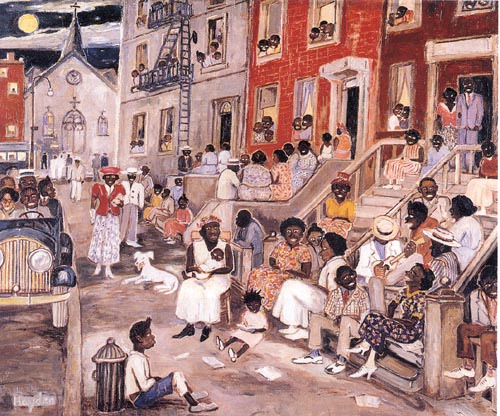
Palmer Hayden

Thursday, March 3, 2011
Let America Be America Again by Langston Hughes
Let America be America again.
Let it be the dream it used to be.
Let it be the pioneer on the plain
Seeking a home where he himself is free.
Let it be the dream it used to be.
Let it be the pioneer on the plain
Seeking a home where he himself is free.
(America never was America to me.)
Let America be the dream the dreamers dreamed--
Let it be that great strong land of love
Where never kings connive nor tyrants scheme
That any man be crushed by one above.
(It never was America to me.)
O, let my land be a land where Liberty
Is crowned with no false patriotic wreath,
But opportunity is real, and life is free,
Equality is in the air we breathe.
(There's never been equality for me,
Nor freedom in this "homeland of the free.")
Say, who are you that mumbles in the dark?
And who are you that draws your veil across the stars?
I am the poor white, fooled and pushed apart,
I am the Negro bearing slavery's scars.
I am the red man driven from the land,
I am the immigrant clutching the hope I seek--
And finding only the same old stupid plan
Of dog eat dog, of mighty crush the weak.
I am the young man, full of strength and hope,
Tangled in that ancient endless chain
Of profit, power, gain, of grab the land!
Of grab the gold! Of grab the ways of satisfying need!
Of work the men! Of take the pay!
Of owning everything for one's own greed!
I am the farmer, bondsman to the soil.
I am the worker sold to the machine.
I am the Negro, servant to you all.
I am the people, humble, hungry, mean--
Hungry yet today despite the dream.
Beaten yet today--O, Pioneers!
I am the man who never got ahead,
The poorest worker bartered through the years.
Yet I'm the one who dreamt our basic dream
In the Old World while still a serf of kings,
Who dreamt a dream so strong, so brave, so true,
That even yet its mighty daring sings
In every brick and stone, in every furrow turned
That's made America the land it has become.
O, I'm the man who sailed those early seas
In search of what I meant to be my home--
For I'm the one who left dark Ireland's shore,
And Poland's plain, and England's grassy lea,
And torn from Black Africa's strand I came
To build a "homeland of the free."
The free?
Who said the free? Not me?
Surely not me? The millions on relief today?
The millions shot down when we strike?
The millions who have nothing for our pay?
For all the dreams we've dreamed
And all the songs we've sung
And all the hopes we've held
And all the flags we've hung,
The millions who have nothing for our pay--
Except the dream that's almost dead today.
O, let America be America again--
The land that never has been yet--
And yet must be--the land where every man is free.
The land that's mine--the poor man's, Indian's, Negro's, ME--
Who made America,
Whose sweat and blood, whose faith and pain,
Whose hand at the foundry, whose plow in the rain,
Must bring back our mighty dream again.
Sure, call me any ugly name you choose--
The steel of freedom does not stain.
From those who live like leeches on the people's lives,
We must take back our land again,
America!
O, yes,
I say it plain,
America never was America to me,
And yet I swear this oath--
America will be!
Out of the rack and ruin of our gangster death,
The rape and rot of graft, and stealth, and lies,
We, the people, must redeem
The land, the mines, the plants, the rivers.
The mountains and the endless plain--
All, all the stretch of these great green states--
And make America again!
__________________________________________________________________________________________
In this poem Let America be America again by Langston Hughes I believe that he is speaking with a voice as an American because he mentions in the third verse "o, let my land be a land where liberty is crowned with no false patriotic wreath". In that line when he says his land he is considering himself an American he lives in the land of America. He is addressing all Americans because in his poem he mentions "for all the dreams we've dreamed" and when he says we i believe he is saying him (being an American) and all the other Americans that believe in America being a land of the free. I think that Langston's tone in this poem is wistful that america will become what it used to be when it was established but since its not what it was he is hatful and feels that American was never America to him. in Langston's poem he uses rhymes but more specially he uses end rhymes, another poetic device that Langston's repetition of the phrases "let america be america again" and "america was never america to me". i think the HR theme that is used in this poem is the history of the negro because in the fourth to last verse he speaks about how he as a negro created america, "The land is mine--the poor man's, Indian's, Negro's, ME-- who made America." i like this poem because i find it interesting all the things that he mentions about america. i agree with his wishes for america to be america again because i do feel that a lot of things have changed in america from what our founding fathers had originally intended
-Jew.
Let America be the dream the dreamers dreamed--
Let it be that great strong land of love
Where never kings connive nor tyrants scheme
That any man be crushed by one above.
(It never was America to me.)
O, let my land be a land where Liberty
Is crowned with no false patriotic wreath,
But opportunity is real, and life is free,
Equality is in the air we breathe.
(There's never been equality for me,
Nor freedom in this "homeland of the free.")
Say, who are you that mumbles in the dark?
And who are you that draws your veil across the stars?
I am the poor white, fooled and pushed apart,
I am the Negro bearing slavery's scars.
I am the red man driven from the land,
I am the immigrant clutching the hope I seek--
And finding only the same old stupid plan
Of dog eat dog, of mighty crush the weak.
I am the young man, full of strength and hope,
Tangled in that ancient endless chain
Of profit, power, gain, of grab the land!
Of grab the gold! Of grab the ways of satisfying need!
Of work the men! Of take the pay!
Of owning everything for one's own greed!
I am the farmer, bondsman to the soil.
I am the worker sold to the machine.
I am the Negro, servant to you all.
I am the people, humble, hungry, mean--
Hungry yet today despite the dream.
Beaten yet today--O, Pioneers!
I am the man who never got ahead,
The poorest worker bartered through the years.
Yet I'm the one who dreamt our basic dream
In the Old World while still a serf of kings,
Who dreamt a dream so strong, so brave, so true,
That even yet its mighty daring sings
In every brick and stone, in every furrow turned
That's made America the land it has become.
O, I'm the man who sailed those early seas
In search of what I meant to be my home--
For I'm the one who left dark Ireland's shore,
And Poland's plain, and England's grassy lea,
And torn from Black Africa's strand I came
To build a "homeland of the free."
The free?
Who said the free? Not me?
Surely not me? The millions on relief today?
The millions shot down when we strike?
The millions who have nothing for our pay?
For all the dreams we've dreamed
And all the songs we've sung
And all the hopes we've held
And all the flags we've hung,
The millions who have nothing for our pay--
Except the dream that's almost dead today.
O, let America be America again--
The land that never has been yet--
And yet must be--the land where every man is free.
The land that's mine--the poor man's, Indian's, Negro's, ME--
Who made America,
Whose sweat and blood, whose faith and pain,
Whose hand at the foundry, whose plow in the rain,
Must bring back our mighty dream again.
Sure, call me any ugly name you choose--
The steel of freedom does not stain.
From those who live like leeches on the people's lives,
We must take back our land again,
America!
O, yes,
I say it plain,
America never was America to me,
And yet I swear this oath--
America will be!
Out of the rack and ruin of our gangster death,
The rape and rot of graft, and stealth, and lies,
We, the people, must redeem
The land, the mines, the plants, the rivers.
The mountains and the endless plain--
All, all the stretch of these great green states--
And make America again!
__________________________________________________________________________________________
In this poem Let America be America again by Langston Hughes I believe that he is speaking with a voice as an American because he mentions in the third verse "o, let my land be a land where liberty is crowned with no false patriotic wreath". In that line when he says his land he is considering himself an American he lives in the land of America. He is addressing all Americans because in his poem he mentions "for all the dreams we've dreamed" and when he says we i believe he is saying him (being an American) and all the other Americans that believe in America being a land of the free. I think that Langston's tone in this poem is wistful that america will become what it used to be when it was established but since its not what it was he is hatful and feels that American was never America to him. in Langston's poem he uses rhymes but more specially he uses end rhymes, another poetic device that Langston's repetition of the phrases "let america be america again" and "america was never america to me". i think the HR theme that is used in this poem is the history of the negro because in the fourth to last verse he speaks about how he as a negro created america, "The land is mine--the poor man's, Indian's, Negro's, ME-- who made America." i like this poem because i find it interesting all the things that he mentions about america. i agree with his wishes for america to be america again because i do feel that a lot of things have changed in america from what our founding fathers had originally intended
-Jew.
Monday, February 28, 2011


I think that Jacob's art is influential because like this art piece here he draws black Americans working jobs, being successful and dealing with the racismt, because in the 1920's/30's America was very racist so it was hard for a black American to work and deal with all this racism but Jacob's art work kept people influenced and inspire to keep pushing through the hard times.
Thursday, February 24, 2011
Follow!
hey guys! follow my friends Phoebe & Avery!!
PHOEBE: http://phoebeharlemrenaissance2011.blogspot.com/
AVERY: http://averrager.blogspot.com/
PHOEBE: http://phoebeharlemrenaissance2011.blogspot.com/
AVERY: http://averrager.blogspot.com/
Wednesday, February 23, 2011
Subscribe to:
Comments (Atom)